Wednesday, 3 February 2016

9 Frame Analysis - James Presland

Lolo (Delpy,2015)


My A3 page analysis: 
This A3 sheet shows and descries when certain visuals appear ( this is the line along the top of the page). It also shows when certain text and cresits appear on the screen ( this is the middle bar). The other aspect this A3 sheet shows is sound/audio. This involves music and sound effects.( this is the bottom bar).

9 Frames: 

Frame 1: this is the first scene of the film, this introduces the style of the film as it appears to be childlike. This is a common theme throughout the whole opening sequence.The colour of the shot makes it appear as though the setting is a beach as the colour is a golden yellow much like sand. The lines of the screen may also represent waves as they as placed in a waved position. 

Frame 2: This frame consists of a label on what appears to be a moving silky blue background this could also be seen as a book and a title. The colours in this frame are very interesting as they are mostly calm and gentle blue shades this may represent the calm before the storm, this is because we can hear the audio of the music getting louder and heavier almost like a crescendo. The font in this frame appears to be very italic and rustic like it has been hand written rather than using a computer generated font. The camera shot also remains to be a medium shot.

Frame 3: In this frame we see the colour palette completely changed from melancholic and gentle blue colours to a more vibrant and bright orange set of colours. The only piece of font and credits in this frame is the name ' Julie Delpy' who is the director of this film. The colours almost flicker from purple to orange this may have an effect of watching a static television or being at the beach with the different shades of yellow sand.

Frame 4: Frame 4 consists of the title of the film 'LOLO' in huge,bold and colourful capital letters. This use of colours makes the title look attractive as it is also in sections on the letters not just placed on them.The other aspect of this frame which is very obvious to he audience is the figure sitting on the 'O' in 'LOLO'. This figure appears to be wearing a Egg shaped costume, this is very visually interesting and makes the audience feel intrigued. This Camera shot for this frame is a medium shot as it captures the whole title and also the character within the title.

Frame 5: In this frame we see what appears to be a blue mountain/wave . In this shot we also see the character from before who was in the Egg shell costume. In terms of text this frame is very packed and busy. The are many different companies who have contributed to making the film e.g. ' France 2 Cinema' all of the fonts are different and in a variety of colours and sizes.

Frame 6: This frame is very visually pleasing as it shows the main character walking through buildings. The whole frame is through a side view of the buildings. The colours of this frame match the mood and weather. In the scene the weather is raining and the colours which are very dull and almost grey. The only font visible in this frame is credits which are placed on a wooden sign hanging from a balcony door.

Frame 7: This frame shows the character which appears to be the protagonist with another woman who appears to be his lover. The couple dance with credits appear above them in small font which consists of different shades blue.The costumes featured in this frame are a dress for the woman which may represent her being beautiful while the man is wearing a leather jacket and underpants which may represent his laid back approach to everything and shows how he is represented as being the 'cool' one.This camera angle is a wide angle shot as it manages to fit both characters into the frame while also including credits which appear above the characters. 

Frame 8: In this frame we finally get to see the main character in a close up shot. In this we see what he is wearing, this is sunglasses shaped as hearts and also a crown sitting on his quiffed back hair this represents his role in the opening of the film which is to be the cool protagonist. The colours featured in this frame are purple for the background and black and white for the character. The use of purple also makes the scene seem very romantic and quite endearing to the audience.

Frame 9: Frame 9 is very visually intriguing and partly confusing as in the frame we see the main character swimming in a swimming pool however, the orientation of the main character is not obvious. I think this purposely placed ambiguity is a common theme throughout the whole of the opening. The colours used in this frame are shades of blue in a striped pattern. The camera shot featured in this frame is a long shot as the main character appears to be small in comparison to his surroundings.



9 Frame Analysis - Osbert Menezes

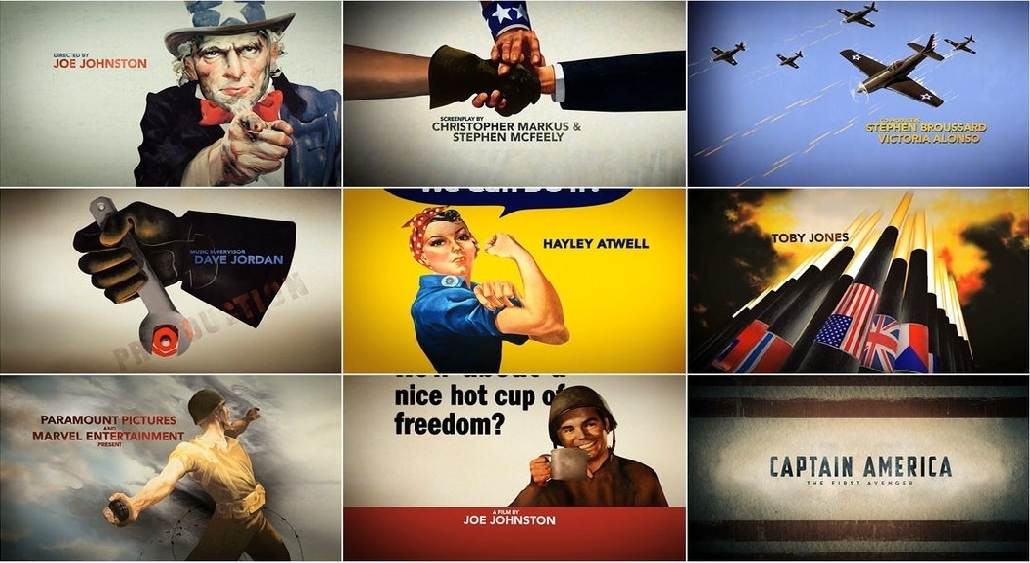
Captain America: The First Avenger (Johnston, 2011) 9 Frames-


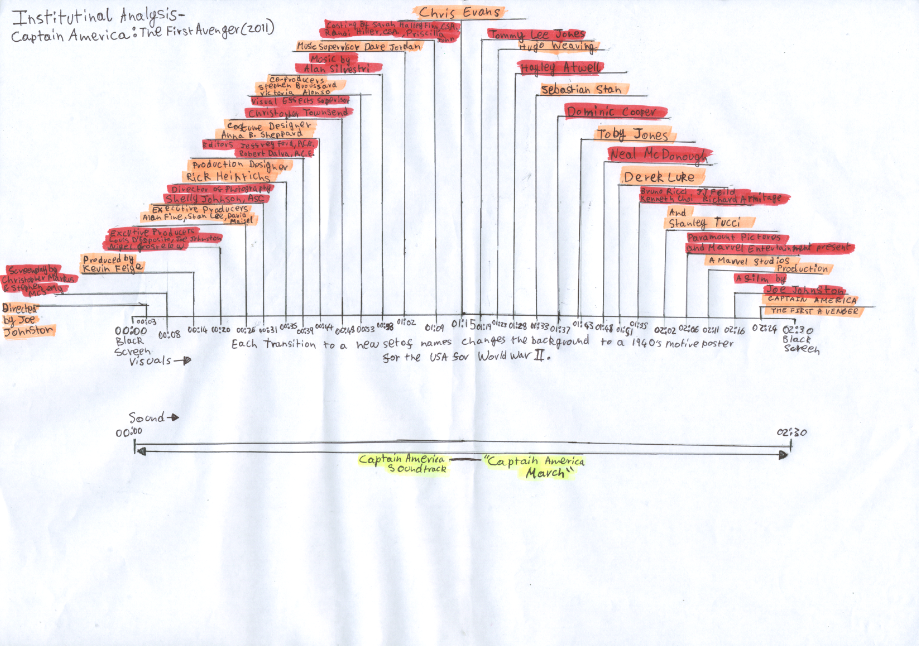
Analysis- https://www.text2mindmap.com/xvxpUZD

Credits Analysis -

9 Frames Analysis - Kyle Quadra


Taxi Driver (Scorsese, 1976) 


The Opening

The opening to the film features credits for the Distribution Company and Production Company, being the 'most important' and common credits to feature in an opening sequence to a film. It is followed by the name of the starring actor and eventually the film title; 'Taxi Driver'. 
It then features a sequence of credits to Editors, Producers, the Director and a selection of the rest of the cast. Along with the main roles in the credits, there are also other key crew members that are involved with the film. They would include; costume designers, casting managers and cinematographers. 


Monday, 1 February 2016

Preliminary Task Evaluation - David McConnell

Original video


https://www.youtube.com/watch?v=0iFlZlkSwbI

Brief

We were tasked to produce a short film that showed specific skills and actions. The film would need to show continuity editing, match on action, the 180° rule, shot reverse shot. These were all included in our film.
Match on Action


This is where one shot seamlessly cuts to another. Here we can see that as the character walks through the door, the camera moves inside and we see him walking through.

180° rule and shot reverse shot

The 180° rule is where the camera stays on one side of the conversation. As is shown in the picture below, the bottom three cameras show the pink person on the left and the blue person on the right but the top camera would show the blue person on the left and the pink person on the right. We used the 180° rule with shot reverse shot. Shot reverse shot is when the camera switches between the two characters while they are in a conversation.

180° rule


Pre-Production

We had limited planning for this so the pre-production was rushed as we didn't have enough time.

Storyboard

We were unable to create a storyboard which meant the two films we created (we were split into two groups to create two films) turned out very different

Example storyboard


Story

We quickly decided that we wanted to do something in the spy genre as we were able to construct our film in any genre we wanted and we felt this would enable us to cleverly include each aspect we needed. On our way to the location we quickly planned out what the story would specifically be.

Location

Having being limited to the school grounds, we prioritised going somewhere with little background noise. This led us to the seats by the bike shed. This enabled us to continue and adapt our story as we moulded the script around the various locations.


Preliminary Task Evaluation. James Presland

Preliminary Task evaluation
The Brief
The task requirements consisted of the use of three specific actions and three specific skills. Although this is not a skill nor action we had to show evidence of continuity editing.
The three actions were : sitting, walking and opening and going through a door.
The three skills were :  shot reverse shot, match on action and the 180 degrees rule.

The actions
Walking


Sitting


Opening and entering through a door


The skills
Shot reverse shot


Match on action

180 degrees rule

Pre-production 
Planning the narrative ( story)
In terms of time we were very limited , however the task was very open and the Preliminary task  could be portrayed in any genre. WE were able to plan the narrative of the film verbally for about 10 minuted before we began filming and we were able to also note down general ideas of whats shots we wanted and dialogue.

We settled for the task to follow a thriller/action genre film.We felt that this would be the best choice as it enabled the task to portray the different skills and actions in a large variety of ways.For example, we could use Shot reverse shot in conversation to emphasise tension or use the 180 degrees rule to show the relationship of two people walking.

Choosing the Location.
We were quite limited for choice for this task as we were not allowed outside of school grounds.
However, we decided to use a wide range of different locations from around the school. We used these different locations as it enabled us to expose and take advantage of unique vantage points which could be used to create interesting camera shots and angles. For example, when the camera is mounted high up and takes a photograph of Kyle this was done by setting the camera o top of a locker found near the door of which Kyle entered through.

I think the Pre-production past of the process went very well considering we did not have a lot of time to choose a location, narrative and to come up with dialogue. I think we also worked well as a team. We communicated verbally efficiently , we needed to communicate well about camera shot and angles in order to come to the best decision.

Production
Lighting 
overall Lighting was successful. We filmed during the day so we did not need any additional lighting. However , on that particular day the sun was quite bright and we had to position the camera to ensure no glare from the sun would be seen in the film. the actors also found it difficult to look in certain directions because of this.

Camera
We use a Canon DLSR 650D  for the shooting of our preliminary task. WE had discussed the different camera shots and angles we planned to use for the shoot before we started filming. We were also limited for time during the actual filming of the task. We also had to redo many scenes because of background noise interfering or camera panning difficulties. 

Sound
The sound was recorded using the Canon DLSR 650D  . The sound consisted of mostly dialogue and one sound effect which was the camera taking a picture.However, we had originally planned to record the sound separately on a recording app on a mobile phone however we later realised that the sound and film would not be able to sync up properly so the recordings were not used.

I think the production stage went well . Considering the location we choose and the difficulties surrounding it such as the ambient noise and passing people.

Post-production 
Editing
For the editing the original team was split into two smaller sub teams. We all used the same raw footage , however our finished products were very different. We used the editing program: final cut pro to edit our films. At first the program was difficult to get used to however, it soon became clear how to cut and move footage around. The main feature that we had to had to keep in mind while editing was to produce a film that had great continuity editing.

I think the editing went well despite it being the first time my and partner and I had ever used Final cut pro.

What I learnt.
I have learnt many a wide variety of knowledge while conducting my Preliminary task. 

For Pre-Production, I have learnt that planning out your shots, dialogue, actions for the actors/actresses and camera positioning is very key to having a well planned pre-production. I think next time i would construct a storyboard as this would enable production to be conducted much easier.

For Production, I have learnt that when recording characters far away it is best not for them to have dialogue as the microphone cannot pick their audio up.

For Post-production I learnt that when trying to combine an audio file with visuals without recording them at the same time is incredibly difficult to do.I also learnt many features of final cut pro such as : stabilization, place and cutting visuals and placing sounds effects.


Preliminary Evaluation - Osbert Menezes

Task-

The preliminary task was to show 3 actions and 3 camera skills. We also had to show continuity editing through out the video. The following shows the tasks we used in our extract...
Actions- Sitting,
'Teh mole' - A short film by Dave&Co. - AS Media - Preliminary Task
Walking,
'Teh mole' - A short film by Dave&Co. - AS Media - Preliminary Task
Conversation.
'Teh mole' - A short film by Dave&Co. - AS Media - Preliminary Task
Skills-Match on Action,
'Teh mole' - A short film by Dave&Co. - AS Media - Preliminary Task
Shot Reverse Shot,
'Teh mole' - A short film by Dave&Co. - AS Media - Preliminary Task
180 degree rule.
'Teh mole' - A short film by Dave&Co. - AS Media - Preliminary Task

Pre-Production-

For this preliminary task the research and planning stage was very short. we were given only one hour to plan and record all the footage so it was very rushed and unstructured. the following shows some things we could have improved on while planning or things that went well while planning.

Genre-
One of the aspects we planned and chose before filming was the genre of the task which was a "Bond" type sequence as we found this was best to do portray the skills and actions from the task.
This is an aspect of planning that we did well.

Storyboard-
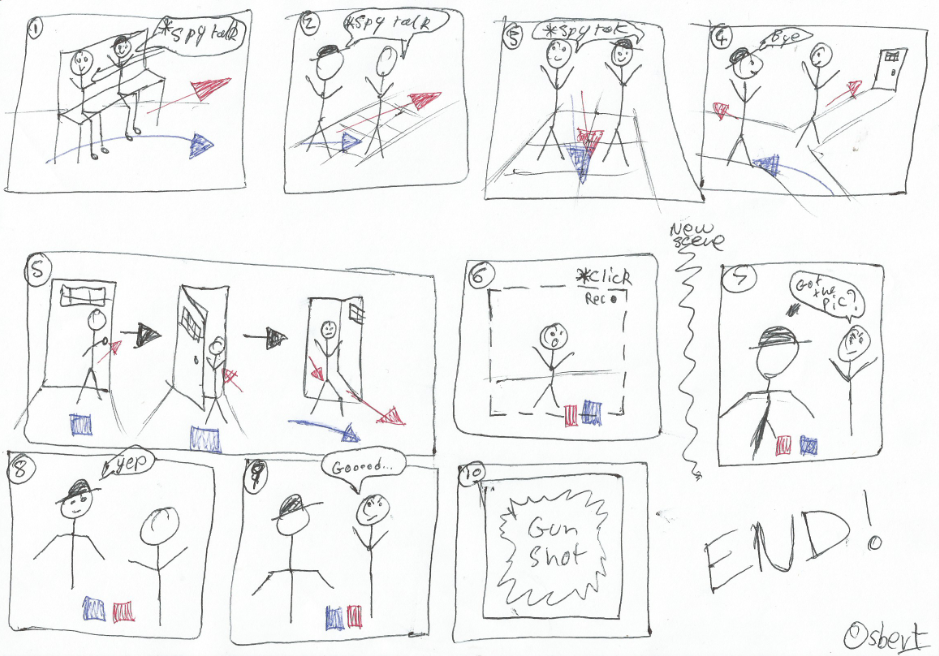
The storyboard is an import part of planning a piece in media. Its to give a basic visual idea of what the scrip is about and how it will look like on camera. It can show the position of the characters relative to the camera (camera shots) and can show their movements and the movement of the camera. It can also give an idea of what the background could look like.

Right is an example of a professional story board that shows a scene. In this story the character goes through the door and gets attacked by another character. this story board shows a screenshot of every transition of camera angle that takes place to show what it might look like when they film the scene. This can give the director and cast an idea of the characters they are playing and scenes they are playing in.

In our preliminary task we did not have time to do a professional style storyboard for our scenes but I took the time after to draw one to show what a storyboard would have looked like for our piece of media (this was a quick drawing of our scenes). This is to show an aspect we could have improved on when doing our planning by creating a storyboard for our scenes for a better understanding of what we were doing. In the storyboard the red lines show character movement and the red box shows no character movement.The blue lines show camera movements and the box shows the camera staying still.

Location- 
In terms of Location, we were mostly limited on what we could have used as we were told to only use school grounds and not enough time was given to use any location that was far way. this limited what we could have done and limited the creativity that could have gone into this task. If we could have done this again we could have given more time on location and chose a more suitable location for the script rather than basing the script around the location.

Production-

The production we had about 50 mins to film everything for the task as 10 mins from out hour was given to planning and location scouting. This ended up causing many problems.

Camera-
'Teh mole' - A short film by Dave&Co. - AS Media - Preliminary Task
The camera work was mostly very well done and clean but few mistakes were made. Our first mistake was early in the extract (right) when we found that the characters walked a bit too quick for the camera pan to keep up and so cause them to be out of frame for a bit of time. this was a minor mistake but did make the shot odd.

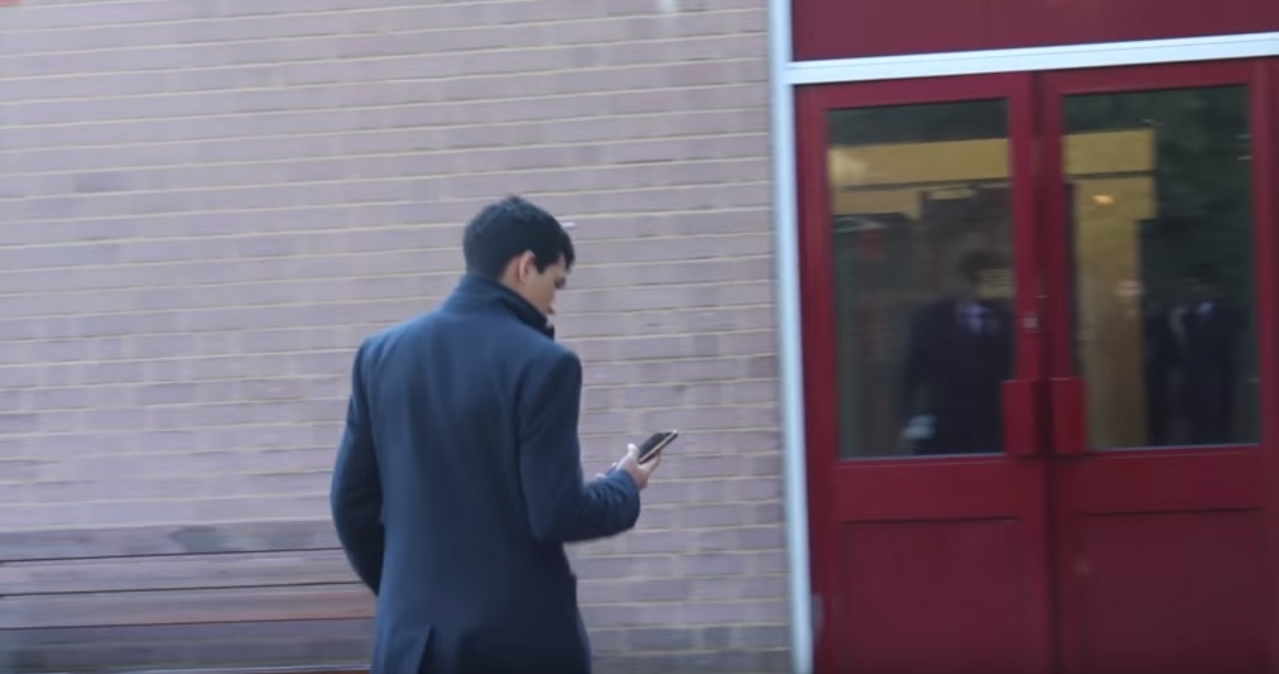
Another mistake was when the characters split we break the idea of film making as a camera and crew can be spotted in the reflection of the window (image below). Though this was mostly cut out in the editing of the extract, a split second of it can still be seen, this broke the idea of continuity editing and could have been fixed if the tapes were reviewed at the time of filming and production.

Both these clips show how we make a few mistakes due to us not having enough time to film and review the clips and so many errors slipped through the editing. If I were to do this again I would try to make enough time to review and re-shoot the scenes to get more perfect camera work.

Sound-
There were many issues with sound in this extract as we did not have the appropriate equipment.The audio from the dialogue was recorded from a recorder app on the phone which one of the characters was holding but when reviewing these in the editing stage these files were not good and had recorded too much background noise so we went with the sound recorded from the camera. the camera sound was to quiet however and also recorded quite a bit of background but we still stuck with it.

It was a smart idea by us to overdub the sound but this failed during the production stages and was not realised until post-production so was one of the main reasons why we use the camera sound. If more time was give we could have used an overdubbed sound, recorded in a studio but this would have been too hard to apply to the lip movements of the characters.

Lighting-
Lighting was not really a problem for a us as we recorded mostly in the day and almost everything was naturally lit. Even the darker scenes were not dark enough to not see what was happening so the lighting was an overall success in this preliminary task.

Post-Production-

Editing-
Most of the success from this extract came from this stage as the editing was done quite well in my opinion. One way this is shown is through the amount we managed to do with the limited footage we had. the majority of the footage was bloopers as most of them ended up with someone laughing. We avoided this by cutting scenes before anyone laughed. However this did create a small issue in the extract as you can notice some points were someone was going to laugh so it still can be improved.

The use of the camera flash clip near the end (below) was something that was edited in using the editing program. However the original plan was to make the frame freeze after the flash to show a picture being taken but due to time issues this could not have been done. If I had more time in editing this could be improved.

'Teh mole' - A short film by Dave&Co. - AS Media - Preliminary Task

Background Music-
Background music could not be put into our extract as it would have been too loud and would have meant that the dialogue would not be heard. This meant that we could not use background music. If we had recorded better sound then we could have used some background music and this could have been a place to improve.


Preliminary Evaluation - Kyle Quadra

The Brief


Preliminary Exercise - Continuity exercise.

The Preliminary Exercise requires students to produce a piece of film in which a character; opens a door, walk across a room, sits down in a chair opposite another character.

Main Task - Titles and opening sequence of a new fiction film.

Technology - Digital video, non-linear editing. 

Theoretical Understanding - the language of film and grammar of the edit, making meaning through moving images, narrative and representation, action and enigma, plot and story, establishing realism and verisimilitude, miss en scene, genre of interpretation.


Actions to Include


Sitting


Walking


Converstation 


Skills


Match on Action


Shot Reverse-Shot


180 Degree Rule


Pre-Production


Story Planning

As we were restrained by time, the research and planning for the task was unstructured and basic. In terms of story boarding, we as a group discussed verbally what we were going to do i.e location for filming, a short narrative, props if necessary. 

We had come to the decision that we were going to follow the Thriller Spy film genre and had discussed a simple narrative, that would be possible to cover within a one to two minute sequence which would include the required key technical areas and actions, as well as deciding what characters should feature in the story and where we would film it.

On the way to the location we briefly sketched out a story board which included the scenes we wanted to capture and how we would capture them while observing the 180 degree rule; that refers to an imaginary line which cuts through the centre of the scene. Crossing this line changes the audience's perspective on the scene which may cause disorientation and confusion, therefore doing this must be avoided.

Location

Being restricted to only the school grounds greatly limited our creativity in terms of finding a setting to creates scenes which complimented our genre. Yet we found the most suitable locations available which would fit into our short narrative. 

Reflection of the Pre-Production Stage

Overall as a team, we knew what we wanted to achieve in the planning stage; to come up with a simple narrative, decide on filming locations and look into how we were going to fit all the key technical areas and actions into the piece of film.
We could improve this in the future by taking more time to develop ideas, draw up detailed story boards with stage directions, camera directions and a script if there is a need for one. This would improve our poor structure and the quality of our final work.

Production


Camera

Setting up the camera on set was not difficult. We had mentally mapped out the scene and discussed where the camera should be placed previously during the Pre-Production stage. Once we got to filming, as we had not properly rehearsed - there were many outtakes. We also had an issue which we found after filming, that the camera does not pan fast enough to keep the characters in frame therefore making the walking sequence seem out of sync and sort of unplanned. Being limited for time meant that we couldn't film multiple takes and therefore couldn't correct this error.

Sound

It was our original plan to record the sound separately to the film footage, this being done on a voice recorder on our phones. This meant that we did not need speak louder for the camera's microphone to pick up the sound, but due to poor organisation and time restraints we couldn't fit it in to match the footage and abandoned that idea.
Another issue was overpassing planes due to the airport nearby. We had approximately half a minute to film a take before the next plane would fly over causing a loud and overpowering rumble making it hard for the audience to hear the characters speech.

Lighting 

In terms of lighting, due to a lack of time it was difficult to plan out how the lighting would effect the scenes. Therefore we resorted to filming majority of the film outside in the natural light. There was no issue as we filmed during the day with reasonably sunny weather. In scenes that took place inside, lighting there too was not an issue due to them being naturally well lit by large windows. The shadows created indoors complimented the mysterious effect created by a hooded, dark character. Hence making this a successful area of the Production stage. 

Reflection of the Production Stage

Improvements to this section would include taking more time to film more takes. Review footage after filming so errors can corrected without having to return to the location later, which is time consuming, and being more organised specifically with the sound files.

Post-Production


Editing and Sound

We divided into pairs were all of us had the same original raw footage. At this stage we pulled together all the footage and skimmed through it to find the best takes to include in the final piece of film. We were limited on the footage as we did not film many takes of each scene.
Once we had the footage we wanted to use, we watched though them closely so that we can link the different shots together seamlessly. This can be seen when the camera switches angle, and the characters are where you would expect them to be, instead of being ahead or behind the place were you saw them before the cut. This adds to the continuity factor.

The sound was not to the standard that we had wanted and as the separately recorded sound would take too long to sort out, we decided to overlay a soundtrack to mask the poor sound and background noise of the ambience outside.
We cut the sound off where there was an important part which would explain the plot, but as the raw sound was poor this is still difficult to hear.

We added effects to the film such as a camera flash as one of the agents enters a building along with the non-diegetic sound of a camera flashing to go along with it.

Reflection of the Post-Production Stage

Overall, this section was successful, as we produced a piece of film which included the key technical areas and actions to a reasonable standard. 
The only way that would improve this section would be to improve the Pre-Production and Production sections by planning our work out in detail.