Looking back at your Preliminary task, what do you feel you have learnt in the progression from it to full product?
When looking at our Preliminary task, I feel that we have greatly developed our skills in film production.
In the Pre-Production stage, all the planning and setting up takes place before the actual production and filming begins. This would include the script, the filming location, the costumes and actors. It was very important that the Pre-Production was done to a high standard and efficiently, allowing the production to begin and making the filming process easier. From our Preliminary Task, we had learnt how to plan for a production. This time as we had more time to plan and develop ideas, the planning was more successful.
In the Production stage, film production begins. Due to our Preliminary Task, we had experimented with various camera angles and so when it came to filming, it was easier to determine what sort of shots we should use in the film and we knew what to do and how to do it, therefore we were more efficient compared to our production time in the Preliminary Task, when we did not have much knowledge of the equipment.
In the Post-Production stage, the editing and finishing touches are completed to finish and produce the film. The Preliminary Task gave us the chance to practice our editing skills so that when it came to the main project, we had some experience and knowledge on the editing software. In the editing stage, we pulled clips that we had filmed into the software, where we modified and cut clips to add into a final sequence. Continuity editing was used to construct a film that the audience would feel as if it was real events taking place, and this was an important factor in making our work successful.
Our film was aimed towards people from 15 years and all ages above. The reason for this was because of the genre of our film being a physiological thriller, which is typically attractive to older audiences. The Protagonist and overall narrative revolves around the age of an adult and therefore it is more likely for the audience to relate to the character.
The film certificate for our film would be a 15 rating, as this is appropriate to the genre of the film and makes the film available to a wide audience.
No-one under 15 is allowed to see a 15 film at the cinema or buy/rent a 15 rated video. 15 rated works are not suitable for children under 15 years of age.
Films with a 15 age rating certificate commonly feature; Violence and strong language, blood and gore, which is found in our opening sequence.
In what way does your media product use, develop or challenge forms and conventions of real products?
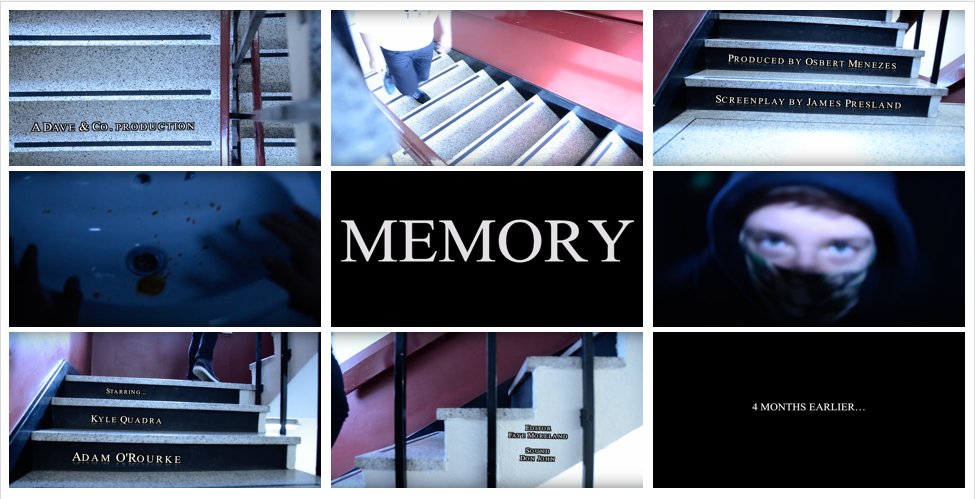
Frames
Production Company
Mid Shot of Protagonist
Low Angle Shot, with Producer and Screenplay writer credits
First Person Shot, blood dripping for suspense
Movie Title
Close up of Antagonist
Low Angle Shot, with Stars credits
Wide Shot, with Editing and Sound credits
Black Screen followed by '4 Months Earlier', continuing the narrative
Analysis
The first frame displays the film's production company. This opening sequence immediately conforms to the conventions of a real film opening sequence, as from my research into film openings; most feature the production company in the beginning of the sequence.
The second frame shows the audience's first glimpse of the Protagonist. A low angle shot doesn't reveal the actor's face, creates suspense and mystery. This is a quite a common feature in openings, where the first person the audience sees is the main character.
The third frame has the credits for the key personnel in the film. Commonly in film openings, these credits appear closer towards the end of the sequence as they are more important. The more important roles are found at the end as they are more likely to stick in the audience member's mind, therefore this aspect of our opening challenges the conventions real film openings.
The fourth frame is a point of view shot from the Protagonist's perspective. The audience is put into the place of the Protagonist and this pulls them into the film's narrative, making them feel a part of the story. It creates a sense of mystery as the audience is yet to find out what is happening, making them want to watch on to find out what happens. Similarly, the purpose of some real film openings, is to pull the audience into the narrative and to make them want to watch on more. It is for this reason that our opening conforms to the conventions of film openings.
The fifth frame is an important part of the opening. It is the name of the film and this formally introduces the film. It conforms to the conventions of real openings as it appears within the first couple of minutes, however there is not a specific point to add this in an opening as many different openings reveal the title at different points.
The sixth frame, similar to the fourth is a point of view shot. Again putting the audience into the place of the Protagonist. It gives the audience their first look at the Antagonist, which is not too common in most opening sequences, therefore our sequence challenges opening sequence conventions.
Frame seven and eight is similar to the third. They both feature the credits for the film's Stars and editors, again conforming to the conventions of film openings, as it is a must for openings to credit key stars in the sequence.
The final frame is of a black screen containing text that allows the film to progress further. Not all films feature this sort of cut into the narrative but with the ones that do feature this cut, our opening successfully conforms to the conventions of the opening sequence of a film.
Costume
The main character is wearing a white t-shirt and dark jeans. The white t-shirt could symbolise purity or peace and the dark coloured jeans may possibly imply a conflict of darkness and evil, which suggests that the main character is troubled and conflicted between good and evil.
The second character is wearing all black clothing with an army camouflage bandana. The dark colours symbolise darkness and mystery and the camouflage bandana suggests a militant aspect to the character.
Production Logos
Our production logos at the start of the opening sequence conform to the conventions of real film openings. The production companies credits are the most important in the opening sequence as they are the sources of funding and distributing the film.
Soundtrack
The soundtrack in the sequence is slow and subtle which builds suspense as the sequence progresses, conforming to the characteristics of thriller films as many films uses this sort of sound to build tension and mystery.
(The audience sees a dark, lonely staircase. We hear a door open; it hasn't been oiled in some time. The scene cuts to the protagonist walking up the stairs) (Insert flashback) (The protagonist falls to their knees, panting is heard) (Cuts to first person) (The protagonist opens an apartment door and sees a women lying there. She is in a wedding dress and there is a visible pool of blood around her; she looks dead) (The camera pans down to the protagonist's hands and there is blood on them) (The camera pans up to a picture frame on a table. In there is a picture of a man and a woman. We realise that this man is the protagonist) (The protagonist turns back to the woman and sees that she is holding a rose) (The rose begins to age and a petal falls off) (The camera zooms into one of the petals) (The title sequence is shown)
I have included below a list of camera shots and angles that will be included in our opening sequence, followed by a brief explanation of the shot and why it is used.
To create mystery and suspense at the beginning we have decided to not show the main character's face, as the audience will be put in the main character's place. So to do this a series of CUT-IN shots will be used showing the character's feet and lower half of the body.
Our opening sequence will feature short flashbacks which will be filmed in a Point-of-View of the main character, putting the audience into the place of the main character. This will be filmed using a GoPro camera that will be attached to the head of an actor using a harness.
We will use establishing introduce the scene, it will provide an overview of the scene giving the audience an idea of where the action will take place. It would usually be a wide shot for an extreme wide shot of the scene.
Here are a couple of images we took showing the different lighting that can be used
No light
Key Light
Fill Light
Back Light
Key Light & Fill Light
Key Light & Fill Light & Back Light
Overall we felt that using just a back light or fill light would be best for our thriller opening as it doesn't illuminate the person's face too much, which means that it creates a spooky atmosphere as we don't know what they truly look like. We didn't want to use no light at all as this would mean we wouldn't be able to distinguish between the person and the background, thus looking like a black screen in the final product.
Interview with a person that fits our audience demographic (15+)-
This is an interview I did with a participant (Patrick Boutros) he is 16 years old and likes to watch films. He said he was familiar with the thriller genre and stated how he had at least one thriller film he enjoyed (Inception). He stated also stated that higher age ratings meant that its easier for a film maker to be more creative as it allows them to do more and so create a better viewing experience for the audience member.